These tasks shouldn’t take up your workweek. But when systems fall short, they do. If you’re a small or mid-size business owner or HR leader, you probably didn’t get into this role because you love tracking down time-off requests, chasing signatures, or answering the same benefits question 14 times.
And yet… here we are.
Studies show that small business owners spend about 16 hours (or two full days) per week on HR-related administrative work.
Most businesses lose valuable time to the slow drip of small, repetitive “this will only take a minute,” tasks that quietly eat up the workweek. Add them up, and suddenly your strategic HR goals, like recruitment, retention, and leadership development, get pushed aside.
Here are some of the most common areas that may be draining your time.
Time-Consuming HR-Related Tasks
They seem small. But over time, these tasks drain your attention, your energy, and your progress.
1. Repetitive Tasks and Rework
Every time you hunt down a missing signature or resend login details, you lose time you could be using elsewhere. The common offenders? Answering the same employee questions over and over:
“How do I add my baby to insurance?” “When do benefits start?” “How many PTO days do I have left?”
Sound familiar?
Individually, these are quick answers. Collectively? They’re a constant interruption machine. When you stop to respond, you lose focus, break momentum, and push higher-value work further down your list.
🛠️How To Fix It:Uncover the pain points.Which areas are bogging down the process due to repetition? Where can you create a self-service culture? This can mean establishing a simple internal HR hub (in your intranet, shared drive, or HR platform), short FAQs on benefits, PTO, payroll timing, and onboarding, or short videos that walk through routine processes.
Then, train employees to go there first. When someone asks a repeated question, send the link along with your answer. Over time, behavior shifts. HR becomes a source, not a help desk.
2. Correcting Payroll Errors
The latest software makes running payroll seem easy, but if something goes wrong, the liability is still yours. Miscalculating pay, outdated tax information, and manually tracking time off are time-consuming to fix, hard to catch, and expensive if you don’t, not just in terms of costs but also in lost time and eroded trust among your workers.
🛠️How To Fix It:Automate what you can.Look for tools that let employees request time off directly, route approvals to managers, automatically update balances, and sync with payroll.
When automation handles the basics, HR shifts away from data entry to policy guidance. You’ll still handle exceptions, but you won’t be stuck crunching numbers late at night.
Or leave it to the experts by outsourcing payroll to an IRS-certified PEO. A PEO can simplify the payroll process with a cloud-based payroll portal for employers, online employee access to pay stubs, W-2s, benefits info, employee handbooks, and secure, paperless direct deposits. They can also take care of onboarding, payroll taxes, IRS deposits, benefits administration, compliance guidance, and provide HR support.
3. DIY Compliance Monitoring
Labor laws change constantly. Posting requirements update. Salary thresholds shift. Leave laws multiply. Keeping up with shifting deadlines, state-level compliance requirements, and studying the IRS’s recently updated guidance under the One Big Beautiful Bill Act. Trying to monitor all of this yourself is not only time-consuming – it’s also stressful.
One misstep can be costly. In 2025, the Department of Labor’s Wage and Hour Division recovered more than $259 million in back wages for nearly 177,000 employees. That’s an average of $1,465 per worker (the most since 2019).
🛠️How To Fix It:Don’t carry compliance alone.Get expert help by partnering with a professional. Whether it’s through a PEO, outside counsel, or a compliance partner, get support that keeps you updated on requirements that apply to your business.
You’ll need advice on tricky employee situations, alerts on multi-state regulatory changes, new pay transparency rules, evolving paid leave requirements, changing wage-and-hour laws, new employment-related laws on AI, and much more.
🚀 Pro Tip: Stay compliant with our HR Checklist covering the latest updates and deadlines related to compliance, benefits, payroll, and general HR that you need to take care of each quarter. Download your free HR Checklist ➡️ HERE
4. Updating Employee Data in Multiple Places
Name changes. Address changes. Promotions. New pay rates. If you’re entering the same update into payroll, benefits, retirement platforms, and internal trackers, you’re doing triple-plus work and increasing the chance of errors.
🛠️How To Fix It:Integrate your systems, invest in HR technology, or work with a PEO. A unified HR platform can help connect payroll, benefits, time tracking, and employee records, among other things.
With better integration, changes flow through automatically. That means fewer entries, fewer errors, and more free time.
5. Handling Every Employee Issue Personally
When you’re the only go-to for every conflict, complaint, or issue, your day gets hijacked fast. Some things absolutely belong with HR. But many could be resolved earlier and better by trained managers.
🛠️How To Fix It:Upskill your managers by teaching them to give feedback,handle minor conflicts, anddocument specific issues. This doesn’t remove HR from the process; rather, it elevates the role, moving them from firefighter to advisor.
Stop the HR Busy Work, Amplify Your Impact
Normalizing HR busy work has real consequences, including burnout. Your top performers may feel overwhelmed by constant overtime or pressure to meet demands. It also creates dependence on key team members, making it difficult to delegate when only a few people hold essential knowledge or responsibilities.
Maintaining inefficient processes limits growth, slows project delivery, and prevents your team from focusing on strategic initiatives.
🛠️How To Fix It: Partnering with an IRS-certified PEO can help. By taking on time-consuming tasks, PEOs help small businesses get back more time to focus on productivity and growth.
In addition to saving time, a PEO can also save your business money by identifying inefficiencies, streamlining HR processes, and helping you make critical cost-cutting decisions.
If you constantly feel behind, the fix isn’t more hustle. It’s better tools, clearer processes, and the right support. A PEO can help you stop the small stuff from piling up, so you can invest your time where it matters most. And if you need help, just give us a call at📱 800-446-6567
Find Out What a PEO Can Do for You
If you’re a small to mid-sized business, a PEO can lighten your workload and strengthen your operations. Imagine focusing on growth while experts handle your payroll, taxes, benefits, HR, and compliance.
⬇️Read more about the advantages of working with a PEO in our series:
🔷 HELP WANTED: HR Team or PEO Partner
Investing in an HR team versus partnering with a PEO, which path is best for your small business? As your business grows, managing HR gets complicated – fast.
Should you build your own HR team or explore the benefits of partnering with a PEO? Here’s how to decide which choice best fits your business. ➡️Link #1Link #1Read More
🔷 NEW RESEARCH: More Small Businesses Are Turning to PEOs
Compelling research from the National Association of Professional Employer Organizations (NAPEO) shows that PEOs are helping small businesses scale – a game-changer in 2026.
Working with a PEO isn’t about outsourcing; it’s about upgrading how you manage HR. It’s about investing in smarter growth, happier employees, and peace of mind. In a business world that’s only getting more complex, that’s a benefit worth having on your side. Thousands of successful businesses are already doing it – and the data proves it works. ➡️Link #2Link #2Read More
IT’S HERE!
Your FREE HR Checklist
Here’s your checklist of important tasks related to payroll, benefits, compliance, and general HR.
About Propel HR.Propel HR is an IRS-certified PEO and a leading provider of human resources and payroll solutions for 30 years. Propel partners with small to mid-sized businesses to manage payroll, employee benefits, compliance and risks, and other HR functions in a way that maximizes efficiency and reduces costs. For more information, visit propelhr.com
Productivity is the secret sauce that separates teams stuck on the sidelines from those with winning streaks. Chances are you’re juggling hiring, compliance, benefits, culture, and about a dozen other priorities . . . all while the clock keeps ticking.
Your power play? Outsourcing. When used strategically, it boosts productivity, streamlines operations, and frees you up to focus on what actually moves the scoreboard – your bottom line.
First Quarter: What Productivity Really Means
In HR, productivity isn’t about sprinting faster – it’s about running the right plays at the right time.
True HR productivity means delivering meaningful outcomes with minimal wasted effort. Speed matters, sure, but impact matters more.
Fast hiring doesn’t matter if turnover remains high. Smooth payroll is great . . . unless errors keep forcing replays.
At its core, productivity is about consistent, high-quality execution that supports your business year-round.
Here’s the basic stat line. The fundamental formula HR teams use looks like this: Productivity = Total Output / Total Input.
🎯Stronger Compliance Defense. Mistakes lead to fines, audits, and penalties – that’s expensive. Productive HR keeps risk off the scoreboard.
🎯Scoring Efficiency. In the Red Zone, the stakes are high, and scoring opportunities significantly increase. When your HR team isn’t buried in paperwork, they can make a more strategic impact by focusing on culture, performance, and growth.
🎯Leadership Trust. HR shifts from order-taker to trusted partner.
The results? A productive HR function is the engine that keeps your people – and your business – moving forward.
The Stats Don’t Lie: Proof from the League
The data backs it up:
➡️Flexibility & Remote Work. A Gartner report finds that 43% of employees working flexible hours say they are more productive. Gallup found that fully remote workers report the highest engagement levels.
➡️Engagement Matters. Highly engaged teams are 17% – 21% more productive than disengaged ones.
➡️The Productivity Gap. Top-tier companies grew more productive, while others saw declines due to inefficient collaboration and low engagement.
🎯Winning teams don’t guess; they measure, adjust, optimize, and power up.
The Box Score: Common HR Productivity Metrics
To know how your team is performing, you need the right stats:
📊 Output Metrics. Revenue per employee, output per hour, goals completed vs. assigned
📊 Efficiency Metrics. Time spent per task, employee utilization
📊 Quality Metrics. Accuracy and impact, not just speed
📊 Engagement Indicators. Engagement scores and absenteeism.
📊 Financial Metrics. Total Cost of Workforce (TCOW)
These numbers tell you whether your plays are working and what needs to be redesigned.
A PEO helps improve productivity by offloading time-consuming tasks while strengthening the entire employee lifecycle through MVP expertise and next-level HR tech.
🔥Think of it as adding multiple Tom Bradys to your roster.
THE GAME PLAN
Play #1: Reallocate Resources to Core Strengths
The fastest productivity gain comes from freeing your teams from admin overload. By outsourcing, you get:
✅Time Savings. Business owners can spend 20+ hours per month on HR admin-related tasks. Outsourcing frees up time for growth, sales, and strategy.
✅Administrative Relief. Payroll, benefits enrollment, and multi-state compliance tasks move off your plate and into expert hands.
✅A Team of MVPs. Outsourcing gives you access to a team of pros, ready to help when you need it.
Play #2: Build a Deeper Talent Bench that Flexes
An engaged workforce is naturally more productive.
💼 Lower Turnover. Companies using PEOs see 10%–14% lower turnover, reducing disruptions and retraining time.
💼 Big-league Benefits. PEOs provide access to Fortune 500-level benefits, boosting satisfaction and engagement.
💼 Faster Onboarding. Streamlined onboarding helps new hires get in the game.
Play #3: Upgrade Your Tech Stack
PEOs give small and mid-sized businesses access to advanced HR technology without the big-ticket price tag.
📊 Automation.Payroll and tax automation reduce errors and time-consuming fixes.
📊 Employee Self-service. Employees handle PTO, pay stubs, and benefits updates themselves with fewer interruptions for HR.
Play #4: Strengthen Your Compliance Defense
Compliance isn’t optional and managing it internally can drain focus fast. With a PEO on your team, you get:
🛡️Expert Guidance. A team of HR pros helps prevent fumbles and penalties. PEOs stay on top of federal, state, and local regulations, including ACA and FMLA.
🛡️Safety Programs. Proactive safety audits reduce workplace incidents and business disruption.
Play #5: Win on the Scoreboard
All these efficiencies lead to real, measurable stats:
🏆Faster Growth. Businesses using a PEO grow 7% – 9% faster than those that don’t. And are 50% Less Likely to Go Out of Business
💥That’s not just a win – it’s a blowout. It’s the stuff championships are made of.
FINAL CALL: Make Productivity Your Winning Play!
How far can you go? Productivity isn’t a one-time drill – it’s a GOAT mindset.
When you measure what matters, optimize repetitive work, and outsource strategically, you’re not just working faster . . . You’re working smarter. That’s for legends.
🔥Outsourcing is no rookie move. It’s a strategic productivity partner that helps HR shift from scrambling to scoring. And keeping that winning streak hot.
Ready to Turn HR into a Powerhouse?
Ready to hear your crowd ROOOAAARRR? 🎉 This power playbook is your first step.
➡️If you need some coaching or a huddle about your productivity game plan, we’ve got you all the way to the Super Bowl winning streak and beyond – just give us a call.
IT’S HERE!
Your FREE HR Checklist
Here’s your checklist of important tasks related to payroll, benefits, compliance, and general HR.
About Propel HR. Propel HR is an IRS-certified PEO and a leading provider of human resources and payroll solutions for 30 years. Propel partners with small to mid-sized businesses to manage payroll, employee benefits, compliance, risk, and other HR functions in ways that maximize efficiency and reduce costs.
To learn more, visit propelhr.com
If you run a small or midsize business, you already know growth is exciting, yes — but also unpredictable, and sometimes overwhelming. That’s exactly why more business owners and HR leaders are choosing Professional Employer Organizations, or PEOs, not just to outsource HR tasks, but to grow smarter, faster, and more sustainably.
The Top 10
A PEO helps you scale without letting the behind-the-scenes stuff collapse under the weight of bigger payrolls, more onboarding, greater compliance risk, and higher employee expectations. It’s like adding an entire HR department overnight, minus the overhead and recruitment scramble. A few advantages include:
1. You Get HR Infrastructure Before You Actually Need It (Which Is Exactly When You Need It)
Most small businesses don’t feel the pain of HR complexity until it’s too late. Payroll errors start multiplying, employees want benefits you’re not equipped to provide, and suddenly you’re Googling state labor laws at 11:30 p.m.
A PEO lays the foundation before those cracks show. Payroll scales without drama. Whether you have 10 people or 110, payroll stays smooth, compliant, and on time.
Onboarding becomes a real process and not a scramble. Templates, checklists, digital forms, background screening, and automated workflows ensure consistency as you grow.
Policies adjust proactively. A PEO helps you build employee handbooks, update them with new laws, and create clear rules that reduce risk as your headcount increases.
2. A PEO Delivers the Big-Company Benefits Employees Want
Here’s the part that often surprises business owners: a PEO can give you access to benefits packages typically reserved for much larger companies.
Because a PEO pools together employees across its client base, you essentially get to “buy in bulk,” accessing high-quality benefits at lower rates. That means you can offer your team robust health plans, retirement savings options, and other top-tier benefits typically reserved for larger companies (and top talent expects).
🎯When employees enjoy comprehensive benefits without compromise, your company is seen as a long-term career option. Retention rises, and as every HR pro knows, that’s a growth strategy.
3. Compliance Stops Being a Guessing Game
Growth = risk. New states. New regulations. New employment laws. New reporting requirements.
This is where many small businesses unintentionally step into danger territory. The rules change constantly and the stakes are high.
✅They track federal, state, and local employment laws.
✅They help maintain the required documentation.
✅They ensure new hires are classified correctly.
✅They reduce risk with structured workplace policies.
✅And because of the co-employment relationship, many PEOs also share certain administrative responsibilities – meaning you’re not alone if something goes sideways.
🎯Growing is risky. Growing without compliance support? That’s gambling.
4. HR Technology You Don’t Have to Build Yourself
Scaling is smoother when everything is connected, such as payroll, onboarding, PTO tracking, benefits enrollment, performance management, and reporting. But building your own HR tech stack or licensing multiple vendors gets expensive fast.
🎯A PEO delivers the all-in-one HR command center designed for your business. Better data, better workflows, better decision-making.
5. A PEO Frees Up Time (A Lot of It)
If you’re a business owner, your job is to grow the business, not troubleshoot payroll deductions. If you’re an HR manager, your job is to support the people strategy, not drown in admin work.
A PEO takes on repetitive, time-consuming tasks, such as processing payroll, managing benefits, handling tax filings, and preparing compliance documentation. The more you grow, the more time you reclaim, instead of watching your workload escalate with each hire.
6. You Gain a Team of HR Experts Without Expanding Your Staff
Growing companies don’t always have the luxury of immediately hiring a full HR team — HR generalists, benefits specialists, payroll administrators, compliance officers, recruiters, risk managers, the whole lineup.
A PEO gives you access to exactly those roles, on-demand expertise, without the full-time salary load.
Need help rolling out a new PTO policy? Preparing for benefits renewal? Handling a sensitive employee relations issue? There’s an expert for that. It’s like having a seasoned HR department already onboard, ready to advise you every step of the way.
7. You Become More Attractive to Investors and Partners
Here’s something entrepreneurs don’t always think about: investors love operational maturity. When a PEO is part of your infrastructure, it signals you’re compliant, manage risks well, your HR processes are stable and that you can scale responsibly.
🎯For investors, lenders, and potential partners, a strong HR foundation = reduced risk. And reduced risk makes you a better bet. For acquisitions and rapid growth phases, a PEO can also make integration smoother.
8. A PEO Helps You Build a Better Employee Experience
Growth doesn’t just require more people; it requires keeping the good people you already have on board.
A PEO helps you:
✅Improve communication and access to information.
✅Build modern HR processes that employees trust.
✅Provide competitive benefits
✅Create fair, consistent workplace policies.
🎯A better employee experience leads to lower turnover and higher morale. And in high-growth companies, stability is gold.
9. You Can Expand Into New States With Confidence
Need to hire employees in another state? That’s great for growth, but it creates compliance challenges due to different tax rules and labor law requirements.
🎯A PEO handles all of it, letting you recruit the best talent in any location without losing sleep or risking penalties.
10. You Scale Strategically
Growth can stress your business when operations lag behind headcount. A PEO aligns both, so you’re expanding strategically.
🎯The result? Smooth transitions. Predictable costs. Cleaner processes. Less risk. Happier employees. And more time to focus on what actually grows the business — not on what slows it down.
Growth Is Easier ➡️When You’re Not Doing Everything Yourself
If you’re preparing to scale — or even thinking about it — the question isn’t whether you can handle growth alone. It’s whether you should.
With a PEO, growth is a plan.
A PEO delivers the infrastructure, expertise, and stability that power growing companies, without requiring a major investment or a staff increase.
Ready to see what a PEO can do? We can lighten your workload and help you drive growth, just give us a call at (800) 446-6567 or visit propelhr.com
🎯PEO Series: The PEO Difference🎯
Learn more about how a PEO can help your business in our series:
🔶HR Help Wanted: In-house Team or PEO Partner. Investing in an HR team versus partnering with a PEO, which path is best for your small business? As your business grows, managing HR gets complicated – fast. Should you build your own HR team or explore the benefits of partnering with a PEO? Here’s how to decide which choice best fits your business. Read More
🔶Navigating Compliance Minefields. Navigating HR compliance can feel like tiptoeing through a minefield — one wrong move can trigger costly consequences. From pay transparency laws to overtime thresholds, new regulations evolve faster than most small HR teams can keep up with. Here’s a look at the top HR compliance challenges and how to avoid turning small missteps into expensive lessons. Read More
🔶New Research Shows Why More Small Businesses Are Turning to PEOs. The data is in! And it shows how partnering with a PEO will be the smartest move for small businesses in 2026. Recently released research from the National Association of Professional Employer Organizations (NAPEO) shows that PEO partnerships are helping small businesses scale. It’s smarter, more efficient, and a game-changer. Here’s what the latest data shows. Read More
IT’S HERE!
Your FREE HR Checklist
Here’s your checklist of important tasks related to payroll, benefits, compliance, and general HR.
About Propel HR. Propel HR is an IRS-certified PEO that has been a leading provider of human resources and payroll solutions for more than 25 years. Propel partners with small to mid-sized businesses to manage payroll, employee benefits, compliance and risks, and other HR functions in a way that maximizes efficiency and reduces costs. For more information, visit www.propelhr.com
At one point, Hurricane Florence was a Category 4 storm and close to a 5. Those along the east coast braced for its arrival. When it finally made landfall in North Carolina, Florence had been downgraded to a Category 1. But that didn’t stop the storm from wide-spread destruction as it dumped record amounts of heavy rain, 36 inches in some areas. Even after the immediate danger had passed, unprecedented flooding continued for over a week swallowing homes, businesses and disrupting lives.
According to experts, Hurricane Florence could rank among the top ten costliest hurricanes to hit the U.S. with numbers estimated in the billions.
No one could have anticipated this kind of destruction and catastrophic flooding from a Category 1 storm. But disasters, like hurricanes, are unpredictable.
CRISIS IN THE WORKPLACE. CATEGORIES
Hurricanes, a security breach, groundwater contamination, a product recall – no two crisis situations are alike. Each is unique in origin, consequence and solution. The only common element is impact. Here are a few common examples of crisis in the workplace.
Category 1. The Churn.
This is a situation that has the potential to cause damage, such as a rumor or disgruntled customer.
Category 2. The Trigger.
An employee’s video about your business goes viral or a careless quote is tossed out in mixed company, these are unexpected events that happen outside of day-to-day activities that can potentially bring down an entire company.
Category 3. The Threat.
As the eating habits of American consumers began to catch up with them, the entire food industry found itself confronting concerns about nutrition, obesity and ingredient sourcing. This is an example of a situation that slowly builds over time and has the potential for long-term damage.
Category 4. The Situation.
This is an out-of-control event that involves third parties. You receive information that one of your suppliers has been sourcing contaminated ingredients. Your company is now faced with a massive recall.
Category 5. Red Alert.
A hurricane, explosion, a chemical spill are types of situations which requires damage control and requires immediate action.t
A crisis can strike when you least expect it and has the potential to jeopardize lives, assets, reputation and the survival of your business. Here are a few key steps to prepare and protect your employees and your business.
Know Your Risks.
Every company faces different risks depending on location and nature of its business. For example, businesses located near water are at a higher risk for flooding. Banks and financial institutions have a higher risk for armed robberies. Businesses in highly regulated industries are at a higher risk for compliance issues.
Develop a Plan.
Chances are, the crisis you’re about to handle isn’t the one that you anticipated. A few years ago, crisis plans didn’t consider viral rumors, terrorism, privacy or cyber threats. Today, it’s a must. Planning ahead for a potential crisis ensures the safety of employees and makes for a smooth return to business.
Assemble a Team.
How will your business communicate with customers, suppliers and employees in the event of a disaster? Assign a team to coordinate communications with management, supervisors, employees and families, as well as those involved responsible for employees and the provision of support to their families.
Define Communication Procedures.
Businesses communicate with many different audiences. In a crisis, employees will want to know about job security and conducting work responsibilities. Customers will want to know about their orders. Suppliers will want to know about changes in delivery schedules. A company-wide plan should address audience-specific messages and methods for delivering information.
Be Familiar with Health and Safety Regulations.
Under the Occupational Safety and Health Act, employers are responsible for providing safe workplaces for employees and must adhere to standards developed by the U.S. Occupational Safety and Health Administration (OSHA). Businesses are required to notify OSHA if there is a fatality or if there are three or more hospitalized. Other examples include chemical spills, product tampering or contamination. Additional safety tips, etools and other helpful information for employers and workers can be found at www.osha.gov.
Recovering from a disaster, like Hurricane Florence, is a gradual process. Before entering your home or business, turn off the main electrical power and water systems and do not use gas appliances until it’s professionally inspected.
Look for signs of mold contamination and refer to the Center for Disease Control (CDC) for methods on how to safely treat mold. If you have been impacted by the storm or assisting with recovery efforts, the Federal Emergency Management Agency (FEMA) offers safety guidelines for returning to your business or home.
Aid for Individuals and Business Owners.
From locations to access clean water to applying for aid, the Disaster Assistance Improvement Program (DAIP) provides resources and services to assist in relief and recovery.
Loans for Small Businesses.
The U.S. Small Business Administration offers disaster loans up to $2 million to small business to repair or replace damaged and destroyed real estate, equipment, inventory, and other business assets as well as provides loans for working capital.
How You Can Help.
When disaster strikes, every little bit helps. To make the most of your contribution, research the best practices and safest ways to donate cash, goods, or time. To help those affected by Hurricane Florence, NPR has additional information and list of national and local organizations. Visit www.npr.com.
One year after a heart attack, a Texas high school teacher received an unexpected invoice from the hospital for a jaw-dropping $108, 951. The amount owed after the teacher’s health insurance plan had reimbursed the hospital for his care and after he had paid the required $1,400 out-of-pocket to his health plan. The bill was the balance of the hospital’s $165,000 procedure, a charge the hospital defended as “reasonable and customary.”
Balance billing is a common practice used by hospitals to recoup costs. It happens when the hospital believes the cost for the procedure and services are more than what the insurance company agreed to pay. And the insured is left with the surprise charge.
If you are confused about what’s happening with health insurance, you are not alone.
THE JOURNEY TO REASONABLE & CUSTOMARY
How did we get here in the first place? The state of our current health insurance did not happen overnight. It evolved over the course of more than 80 years. Through depression, war, recession, and innovation, our health insurance practices, policies and systems were shaped by the many events in our country’s history. Here’s a look back.
From Snake Oil to Lipstick. Prior to the 1900s, elixirs and potions promised to cure all. Traveling salesmen used pop-up presentations to pitch its magic. Hospitals were institutions devoted to the poor and doctors made house calls.
In the first part of the 1900s, healthcare began to evolve with better medicine, vaccines and more skilled physicians. The wealthy could afford care and those who could not were allowed to pay using a sliding scale or bartered for services. Many paid into a welfare fund to cover an emergency.
Workplace injuries were common and so were the court cases. Individual states began to develop insurance programs to protect employers and their employees. By 1915, employers in 32 states provided some type of workers’ compensation insurance.
The model seemed fool-proof. The injured employee would visit their family doctor and the family doctor were paid by the workers’ comp insurance. But cost-conscious employers found retaining their own doctor more cost-effective. Physicians began to realize their collective power.
THE GREAT DEPRESSION
Prepaid Healthcare. In 1929, hospitals, like businesses, were experiencing the economic impact of the Great Depression. During this time, it wasn’t common practice or affordable to have a checkup. An official at Baylor University Hospital, in Dallas, Texas, hoped to change that. He noticed that even during challenging economic times people continued to buy cosmetics. So he created a way to make paying for health care as affordable as say, the price of a lipstick.
The Baylor Plan. Baylor tested the idea and enrolled a group of public school teachers in Dallas. For 50 cents a month, the Baylor Plan provided patients with access to the hospital’s medical services. The prepaid plan idea took off and launched, what historians and experts believe to be, the beginning of health insurance.
Hospital Service Plans. From the beginning, the idea was not about making money. The non-profit plans were about protecting people and the charitable organizations running the hospitals.
As the Baylor Plan was adopted and spread to other markets, similar plans were introduced which featured enhanced services and more hospital options. As a result, hospitals looked for ways to control quality and turned to the American Hospital Association (AHA) for guidance with developing its standards.
Blue Cross Plans. The AHA committee, designated to approve the hospital plans, eventually became the Blue Cross Commission. Established criteria included the ability to improve welfare, cover costs, and the freedom to choose doctors. In addition, each plan was assigned a geographic market. The AHA adopted the Blue Cross symbol as the emblem for meeting these standards and as a way to differentiate itself from other for-profit plans.
In 1933, prepaid, nonprofit hospital service plans, now called Blue Cross plans, were officially classified as insurance and subject to insurance laws. A separate physician’s plan, or Blue Shield, followed five years later. Blue Cross and Blue Shield eventually merged in 1982.
The framework of a health insurance system was now taking form.
THE WAR ECONOMY
Employer-sponsored Health Coverage Becomes a Benefit. World War II, tax code changes, and labor movements were all factors in the rapid growth of employer-sponsored health coverage.
In the 1940s, more women entered the workforce as companies struggled to find labor during the war. A wage freeze prompted employers to look for new ways to attract skilled workers. Health insurance was added as a benefit and became a bargaining tool.
Tax Laws Make Health Insurance More Affordable. In 1943, the IRS made employer-based health care tax free. In addition, new legislation made health insurance a condition of employment which also gave unions more bargaining power. Employees in industries such as mining, steel, and lumber had access to union or on-site employer clinics. In 1954, new laws made the tax advantages even more attractive.
Employers are now the source of health insurance.
(Next in the series:The History of Health Insurance: The Road to Reasonable and Customary. PART II: The Rise of Care and HMOs)
How much do you make? Shhh…that’s a secret. There are certain topics you shouldn’t discuss in the workplace – and pay is one that tops the list. And while it may be a long-held cultural taboo to discuss compensation, the battle for equal pay continues.
In 1993, Whole Foods was one of the first companies to take the secrecy out of compensation by making salaries available to all employees. It was a move that upended business as usual and as a result, prompted more discussion about wage equality and pay transparency.
TOP 5 FACTORS OF EQUAL PAY
Secret pay practices have been around for centuries. As the face of America’s workforce changed, laws like the Equal Pay Act were created to protect wage discrimination in the workplace. Signed by President Kennedy in 1963, the Equal Pay Act requires equal pay for equal work. Equal pay includes all forms of compensation, such as salary, bonuses, overtime, profit sharing, stock options, life insurance, paid vacation and holidays, and travel reimbursements. Skill, effort, responsibility, and working conditions, all must be the same and performed within the same establishment. Factors for equal pay include:
Experience, Ability, Education, and Training. The issue is what skills are required for the job, not the skills the employee may have. For example, two administrative jobs could be considered equal even if one of the employees has a masters degree.
Working Conditions. This includes the hazards of the job and the physical surroundings, such as temperature and ventilation.
Physical or Mental Effort Required. For example, suppose that both men and women are working side-by-side on an assembly line. An additional employee, at the end of the line, has to lift and move the product to another area in order to complete the work. Because this job requires more effort, it would not be a violation to pay that person more, regardless of gender.
Level of Responsibility Required. A sales professional who is responsible for customer checks has more responsibility than others on the team would justify a pay differential. An employee responsible for turning off the lights at the end of the day would not.
Physical Location. Equal pay applies to jobs performed in an establishment, which the Equal Pay Act defines as a distinct physical place of business, rather than a business with several places of business. In certain circumstances, separate physical locations may be treated as one establishment. For example, if a division of a company hires employees, determines compensation, and assigns the employees to a separate work location, the separate work location is considered as one establishment.
In the 30 years since Whole Foods made its bold move for pay transparency, other companies have been slow to follow. Why? The primary reason most companies shy away from pay transparency is fear. Fear of change and fear of revealing wage inequities. After all, fair business practices do not hide in the dark, but unfair practices, like discrimination, do. Additional reasons include:
Potential Costs. Transparency may result in increased costs, such as salary adjustments in order to bring current employees in line.
Competition Attracting Top Talent. Employers worry that revealing salaries would give the competition an edge to lure their best employees with more attractive offers linked to reward-based compensation.
Justifying Salary Structures. Employers would have to develop or justify their company’s salary structures.
Changes in Employee Behavior. Making salaries open to employees could potentially change employee behavior, such as decreased productivity and resignations.
Shifts from Performance to Pay Comparisons. Transparency creates an opportunity for employees to compare themselves with other employees versus focusing on elevating performance.
BENEFITS OF PAY TRANSPARENCY
Companies with more transparent compensation policies have reported the following benefits:
Attracts Better Candidates. Many companies who practice pay transparency see an increase in applicants with like values who better fit the company’s culture.
Creates Trust & Motivates Employees. By eliminating secrets, transparency creates an environment of trust and promotes healthy competition.
Reduces Gender Pay Inequities. Being open ensures fairness. For example, every position in the federal government has a fixed level, with an assigned pay level. An open salary tier system helps to reduce gender pay inequities.
Reinforces Employee Value. A business has the opportunity to educate employees about salary structures, benefits packages, and to reinforce an employee’s efforts and talents needed for the company’s success.
WHAT YOU CAN DO
Balancing out compensation is no easy task. Here are a few ways other companies are addressing pay transparency.
Start Small. Start the process by introducing the framework of a pay scale so everyone understands the new pay structure.
Assess Current Pay Policies. Review your current performance review and promotion structure and balance out disparities.
Consider a Salary Formula. In 2013, CEO of tech company Buffer listed the salaries of employees on the company’s website, including his own. In addition, the CEO also provided the formula used to determine compensation, which was based on the experience, the job position, company loyalty, and stock options.
Outsource Roles. Outsource activities where competition is a key result. Here, both performance and reward have to be transparent.
IS PAY TRANSPARENCY RIGHT FOR YOUR BUSINESS?
Pay transparency is not an easy decision. And secret or not, the issue is not going away. Being more transparent about compensation doesn’t mean immediately posting employee salaries. But it does mean having clearly defined compensation practices and policies in place.
For a growing number of businesses, merging with another company is an effective business strategy. A merge provides an opportunity to enhance resources, acquire top talent, expand capabilities, broaden market reach and overall, achieve a competitive edge.
For companies where expertise and local relationships are a vital part of the business, such as community banking and certain franchises, merging with a competitor is a much more effective approach to accelerate growth in a new market than it would be starting from scratch.
Although there are many benefits, merging has its share of challenges. According to the Society of Human Resource Management, an estimated 70 to 90 percent of all mergers fail to reach their financial objectives. Why? One of the top reasons is that Human Resources is not included early enough in the process.
While employees are not a part of a balance sheet, they are an essential part of the merge process.
As executive management works out the financial details of the sale, Human Resources is charged with navigating the costs and complexities of staffing, benefits, employee relations, communications, compliance, liabilities and legal issues. All areas that have an impact on a company’s bottom line.
4 Ways HR Delivers Value
Studies show that the more capable an HR department is, the greater the chance of a successful merge. Here are four important areas where HR adds value.
Building Trust. During a period of uncertainty and transition, consistent communications helps to build trust. HR can keep employees informed during the process and provide feedback loops to address concerns and respond to opportunities.
Aligning Workforces. According to Harvard Business Review, on average 30 percent of employees are redundant as a result of a merge. HR can assess talent requirements for the new organization’s workforce and reduce redundancy.
Managing Costs. According to a Deloitte study, “Driving M&A value through HR integration,” mergers are successful when HR plays a leadership role from the beginning of the process.
Protecting Against Liabilities. A merger can reveal a whole new set of employment laws and regulations. Human Resource professionals can help to prevent costly surprises, especially during the due diligence process, by reviewing employee records, such as compensation history, Form I-9, affirmative action plans, employment contracts, OSHA audits, and any open equal employment opportunity claims (EEOC) and litigation records.
If you purchase a company, do you inherit all of the liabilities and employee violations as well?
In addition, HR can investigate state and laws that may impact employees of the organization, such as “successor” laws that address inheriting liabilities as part of a merge.
INTEGRATING WORKFORCES
Every business is unique to its culture and while there are no magic formulas for melding two companies, there are guidelines to consider and proven strategies. Here are a few areas where HR can help.
Pre-merge Preparation:
Assess cultures. How will the management styles impact the new organization? During a merge, there is no such thing as business as usual.
One of the most well-known examples of the importance of combining cultures is between Daimler-Benz and Chrysler. Post merge, Daimler’s reserved, structured approach clashed with Chrysler’s casual, entrepreneurial culture and made it difficult for the companies to unite. When joining the workforce of two uniquely different cultures, look for common ground. It may require developing a completely new internal system and structure.
Determine talent and staffing needs. Clarify roles and responsibilities and establish clear expectations. Create employee profiles based on experience, geographic location, roles and compensation.
Assess employee benefits, incentives and compensation. A merge presents an opportunity to assess employee benefits and compensation and tailor packages specific to the new organization. Identify gaps and align pay structures, stock options, and PTO, as well as retirement benefits. Review incentives and consider affordable alternatives like flexible schedules, remote work opportunities, free parking, and educational programs.
Evaluate HR operating systems. Assess the HR management systems, such as payroll, HRIS, data management tools and technologies and shared services of each organization.
During Due Diligence:
Assemble a Team. Management defines and shapes the culture of the new organization. Enlist the support of leadership to build teams from across all areas to educate and motivate employees. Involving employees creates a sense of ownership in developing the framework of the new organization.
Develop a Communications Plan. Create an action plan to guide the HR process during the merge. A merger is a time of change and uncertainty. Employees are most interested in issues impacting their jobs and health benefits. Avoid confusion and control rumors by keeping employees informed during the process.
Focus on the positive and discuss how things will be different. It’s likely there will be a redundancy in roles and a potential layoffs and relocation. Turn challenges into strengths. Perhaps more locations will provide more opportunities for jobs, education and improved technology.
Provide Training and Education. Training can balance out skill levels and accelerate the integration of employees of the merging company.
Consider Outsourcing HR with a CPEO. The daunting tasks of defining benefits, compensation and contribution plans, payroll, workers’ compensation, as well as the evaluation of liabilities, may be too complex and require outside support. A CPEO, Certified Professional Employer Organization, can be a valuable partner by providing expert counsel during the transition and beyond. The certification is important because it protects the company from any unexpected fines or taxes as a result of an error. In addition, CPEOs can support benefits and unemployment administration, recruiting and hiring, compliance, family and medical leave administration, employment taxes and drug testing.
Redefining Business As Usual
During a merge, the value of Human Resources goes well beyond policies and personnel. From integrating workforces, maintaining productivity, managing costs and protecting the company from unexpected liabilities, HR plays a pivotal role in redefining the new organization’s business as usual.
When I first started my career, my father talked to me about networking and the importance of surrounding yourself with the right people. He advised me to make connections in the community, not just for my own benefit, but also to help others with their success. At that time, I thought “networking” meant going to events and handing out cards. However, over the years, I have realized what my father told me was correct; business is about relationships. Success is not defined solely by my own abilities. It is created by the combination of my talents, my drive, and my connections.
I recently encountered a few problems both at work and at a non-profit I run. These issues had the potential to cause real turmoil and possibly a crisis if they went unsolved. Ten years ago, these events would have caused me great stress and feelings of isolation. But today, I am calmer and better able to solve problems. The first thing I did when the issues arose was to determine who in my network could help me solve these problems. My network stepped up and immediately began to offer help and solutions. With a few phone calls, the major problems were reduced to mere challenges which could easily be solved.
5 Ways to Harness the Power of Your Network
Over the years, I have benefited from the power of the people in my network. My father has taught me many lessons which have helped me cultivate these relationships and form new ones. Here are some lessons I’ve learned:
Don’t burn bridges. This adage is worth repeating. The world is small, and connections are bridges. It is important to never sever a connection with people or organizations when your situation changes, such as leaving a job or losing a client. In the future, you may need help from the people or businesses you leave behind, and it’s better when their last transaction with you was positive.
Your word is everything. Relationships are built on trust and trust is built by following through with your commitments. My father always emphasizes that a simple handshake can be more powerful than a legal document, and he always taught me that no matter what, you must live up to your word.
Give and Take. You cannot expect to receive something if you don’t offer something in return. All relationships, including business relationships, need a proper balance of give and take.
“Building your network is not just about who can help you but is very much about what you can do to help others.”
Show gratitude. In our busy working worlds, it is important to slow down enough and thank those who help us succeed. Whether a shout out on social media or a handwritten note, people have a desire to feel appreciated and a simple “thank you” should never be overlooked.
Never stop connecting. No matter where you are in your career path, building your network is still just as important. Your needs evolve, and your network must as well. Be open to expanding your network in multiple ways. In today’s world, there are many ways to broaden your reach including LinkedIn, business events, and non-work activities. Of course, there is nothing more powerful than sitting down with a new acquaintance and getting to know each other.
The Values of Networking. When I was in my 20’s and my father advised me on the values of networking, I focused on the action of cultivating my network for business purposes rather than focusing on the actual relationships. As I’ve grown older, I appreciate my father’s advice so much more. My network is more than just contacts on my computer. It is a wonderful group of individuals who have helped me throughout my career both professionally and personally. I am grateful for each person and the benefits and lessons I have learned along the way. (Photo: Lee Yarborough and her father, Brax Cutchin)
Today’s workforce is made up of more generations than ever before. Because each generation enters the workplace with different needs and expectations, the traditional methods of hiring, managing, motivating and retaining employees no longer apply. To prevent conflict and keep your employees engaged and productive, today’s employer must find ways to navigate the changing multi-generation workforce.
First, let’s take a look at the different generation profiles.
THE CHANGING FACE OF AMERICA’S MULTI-GENERATION WORKFORCE:
MEET THE 5 GENERATIONS
Generations are defined by their life span and while research organizations and marketers may use different formulas and have different definitions, here is a breakdown of the most common generation workforce profiles:
The Silent Generation: Born 1928 to 1945
Also known as the Traditionalists and the Veterans, the Silent Generation makes up 2 percent of the U.S. workforce. This hard-working generation values and respects authority and a traditional top-down management approach at work. For this generation, everyone pays their dues. A reward, a title, a promotion and respect, all must be earned. They tend to be very patriotic, loyal and not open to new views and prefer more formal method of communication.
Baby Boomers: Born 1946 to 1964
Known as the “me” generation, Baby Boomers are the largest living adult generation. Known workaholics, this group makes up more than 25 percent of the U.S. labor force. Their work status often defines their self-worth and they are loyal to the organizations and employers they serve. Boomers grew up with television and were influenced by the surge of new ideas and programming. Well-educated and ambitious, Baby Boomers value collaboration, equality and ways to advance professionally. They expect some degree of respect and prefer face-to-face communication.
Generation X: Born 1965 to 1980
Also known as the middle child of generations, latchkey kids, post-boomers, and the baby bust, Generation X make 33 percent up of the U.S. workforce. This group tends to be comfortable with rules and authority, are global thinkers, and value diversity. The computer revolution was just gaining traction during the Generation X period, so most are technology literate. Known for their do-what-it-takes mindset, Generation X prefers to communicate directly to leadership and are willing to work as hard as needed to get the job done. They also value work-life balance and are family-focused with men generally taking the lead.
Millennials: Born 1981 to 1996
Confident, independent, out-spoken and optimistic, Millennials are more educated than any other workforce in American history – it’s no wonder this generation is often is in the media spotlight.
According to a Pew Research Center analysis of U.S. Census Bureau data, Millennials are taking the lead and currently make up 35 percent of the U.S. labor market. Next year, Millennials are expected to exceed the 72 million Baby Boomer population.
Also known as Generation Y and GenNext, Millennials entered the workforce in the midst of an economic recession, the girl’s movement, reality shows and school violence. In the workplace, they are goal-oriented and expect recognition for all achievements and immediate feedback. For Millennials, respect is earned and not something based on years of employment. They support only companies, brands and causes they trust. They value job flexibility and want to have control over their career. Millennials were raised to believe that everyone wins, so they often resist the boundaries of traditional 9 to 5 employment.
Because they grew up during an era of “edutainment,” where lessons were blended with programming, such as Blue’s Clues and Schoolhouse Rock, Millennials value education and learning that is fun.
Also, known as the iGen, Linksters, and Post Millennials, at 21 years of age, Generation Z is just beginning to emerge and represents 5 percent of the U.S. workforce. Because they grew up around digital devices, this group is very tech savvy and have large social networks. They are quick to make a decision and in return, expect a quick response. They are highly connected multi-takers, who think globally and value individuality and experiences.
HOW-TO MANAGE MULTI-GENERATIONS
According to the U.S. Bureau of Labor Statistics population survey, 56 million Millennials, adults between the ages of 21 and 36, were looking for jobs or employed in 2017. That’s more than Generation X at 53 million, who account for one third of the U.S. labor market and 41 million Baby Boomers. While the Baby Boomer generation continues to retire at a rate of 10,000 per day, this group as a whole, is still engaged in the workplace.
Tech savvy new graduates, outspoken change-agents, task masters, collaborators and workaholics must now all work side by side. It’s the new reality.
Here are a few ways to pull all generations together under common ground.
For employers, it’s helpful to know the demographic profile of the available local labor force. For example, if your business is located in Austin, Texas or San Diego, California, where Millennials make up more than 27 percent of the population, you may use Twitter as the primary recruitment tool to connect with job seekers.
Provide training and development opportunities. Millennials are marching into the workplace educated, tech savvy, and not afraid of change – or of sticking around for a job. According to a 2016 Deloitte survey on Millennials, 71 percent of Millennials are more likely to leave a job within two years because of the lack of opportunities for education and leadership development.
Shift management styles. Understanding the needs of each generation, managers have the opportunity to retain and motivate talent. Millennials are more engaged when coached rather than supervised. Generation X employees may work more effectively when partnered with a mentor, while Baby Boomers may be more productive when supported by professional development opportunities. And for the Silent Generation, acknowledging their experience, providing necessary training activities along with a little respect goes a long way.
Play to generational strengths. Every group provides opportunities to learn from one another. Harness the unique strengths and experiences that each group bring to your business. Allowing employees, of all ages, to make decisions and solve problems, goes a long way in building trust. Differences in the workplace create opportunities for employers to evaluate current hiring practices, internal procedures and encourages new thinking for attracting, retaining, and engaging the best employees.
Find the best way to communicate. Every generation has its own way of learning, working and communicating. Conduct a simple survey to find out the best methods for connecting with your employees. Just in the way companies search for the right marketing strategies to reach customers, employers have an opportunity to find the best communication tools to reach employees.
For example, Millennials and GenZ tend to spend more time on messaging apps than any other generation group, while older groups tend to use email more to communicate. Whether face-to-face, email, Skype or text, you may find the need for varying mix of communications methods.
Find out what each generation values. Whether it’s a work life balance, flexible hours, recognition, or professional development opportunities, each employee values something different. For example, Baby Boomers are ambitious and may value opportunities that enhance their careers. Generation X values a work life balance. Deloitte’s survey on Millennials found that when Millennial candidates weigh offers of similar financial incentives, other factors come into play, such as work life balance, flexible work opportunities, training programs and professional development, as well as an inclusive, supportive culture with supportive leadership.
Millennials want to be engaged at work and involved in unique experiences which means organizations may need to redefine the existing programs, policies, and perks currently offered to employees. Understanding these how these factors play with each generation will help employers attract and retain the best of talent.
Partner with mentors. We can all learn from one another and having a mentor is a valuable professional benefit for any age group. In the same Deloitte survey, 94 percent of Millennials said that a mentor provided helpful advice and was important to the job because someone was overseeing their professional development.
BRIDGING THE GAP
As they get older and secure more leadership roles, Millennials will continue to have a more pronounced influence on the workplace. In the future, expect more of an emphasis on such areas as feedback, core values, ethics, work-life balance, and purpose not profit at the forefront.
The face of the workforce is constantly changing. Success depends on how your company responds. The better you understand the profile of your workforce, the better positioned you will be to move your business forward.
As the mother of two daughters, our household is full of “girl power.” My daughters believe they can do anything and that they are not limited by their gender. So, how do I explain to them that in 2017, women earned 82% as much as men? My husband and I focus on education and the benefits it provides for a lifetime; how do I explain to my high school daughter that she will most likely make less than her male peers right out of college?
There are many reasons that pay disparity still exists: training, negotiation skills, caregiving roles, and unconscious biases. Men, women, and businesses have all been a part of creating this inequality in our workplaces, yet most people believe that men and women should receive equal pay for equal work. According to Lean In, 75% of Americans think the gender pay gap is unfair and only 16% think companies are doing enough to close the gap. Many aspects of this issue are cultural and will take time to resolve, yet there are specific things that companies can do now to help close the pay equity gap.
Perform a wage analysis – It is possible to have a wage gap problem and not even know it. Best practice is to hire an outside firm who specializes in compensation review. Senior leadership should be involved and committed to act if disparity exists.
Establish pay ranges for each job description –Before interviewing candidates for a job, a pay range should be determined and posted along with the requirements. This will help curb any unconscious bias and help both the candidates and company know the parameters surrounding wages.
Avoid salary history questions –The average woman will lose more than $530,000 over the course of her lifetime because of the wage gap, according to the Economic Policy Institute. If women start off their career being paid less and with each new job they are asked about their salary history to determine future compensation, then they can never catch up. Nine states have adopted laws that prohibit employers from requesting salary history from candidates. Best practice is to avoid this question and base salary on the established pay range of the job.
Consider work flexibility – Women are often financially penalized for being the primary caregivers in their family. If feasible in your work environment, consider more flexibility so that all employees can perform their job successfully and still maintain a work-life balance.
The burden to narrow the gender wage gap does not fall on businesses alone. Women have a responsibility as well to not only fight for equal rights but to be a part of the solution. The pay gap won’t change overnight and I realize that my daughters will also have to work towards equity. When it is time to begin their careers, I hope they will remember my motherly advice: negotiate salary with skill and confidence; know what your job is worth in the marketplace; find a mentor; don’t be afraid to use your voice; and most importantly,Work Hard.
When Minneapolis employment agency received a “Notice of Inspection” from the U.S. Immigration and Customs Enforcement (ICE) agency, requesting a review of Form I-9 for all employees within five working days, the company responded two weeks later with a delivery of four boxes of documents. As a result, the company was slapped with a staggering fine of $209,000 for Form I-9 violations.
A small business providing transportation for individuals traveling to medical appointments was also hit with $109,000 in penalties for Form I-9 errors.
Stories about Form I-9 penalties are increasing, as well as the rumblings about the potential mandate for enrolling in E-verify, the online employment verification system. And employers nationwide are taking notice.
YOU’RE HIRED
Finding the right talent is more than a challenge. It’s an endurance test. It begins with an exhaustive search through volumes of resumes and applications followed by a marathon of interviews. Then you find the one. The candidate accepts the job and agrees on a start date. Now for the final hurdle – Form I-9.
UNPACKING THE PROCESS:
IDENTITY VERIFICATION AND WORK AUTHORIZATION
Until the Immigration Reform and Control Act was signed in 1986, a swelling workforce of undocumented workers in the U.S. were subject to substandard working conditions, discrimination and lower wages by employers who supported a business model that relied on the cheapest labor regardless of immigration status. The new law hoped to change that by holding employers accountable for the legal status of their workforce. Ultimately, this act led to creating Form I-9 and employment eligibility verification. It required jobseekers to prove their work eligibility and employers to certify that the information and documents provided appeared to be genuine.
Since then, Form I-9 has been a legal requirement for employment in the U.S., for both citizens and non-citizens. Here are the basics.
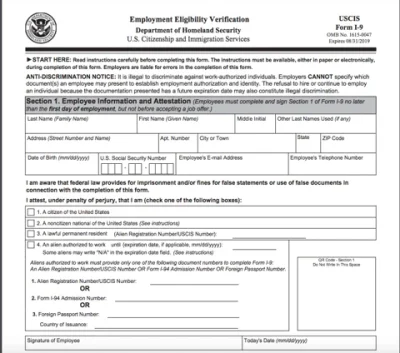
Form I-9 has three sections and has to be completed by the employee and the employer:
Section I: Employee Information. The employee provides information and documents to verify citizenship or immigration status and work eligibility. This section must be completed on the first day of employment.
Section II: Employer Confirms Accuracy. The employer is responsible for reviewing and confirming the accuracy of the information and documents provided by the new hire. The employer must complete this section within three days of a new hire’s start date.
Section III: Employer Re-Verifying Work Authorization. This section is used to re-verify an employee’s work status, once employment authorization has expired or if documents have expired.
While Form I-9 was helpful in many ways, it could not solve the issue of illegal immigration alone. A decade after Form I-9 was mandated, new and tougher immigration legislation made hiring undocumented workers a crime. The idea was that stricter laws would eliminate job opportunities for undocumented workers and lead to a decrease in illegal immigration.
Enter E-Verify. In 1997, the U.S. government launched E-Verify to help employers expedite the work authorization process of new employees.
Here’s how it works:
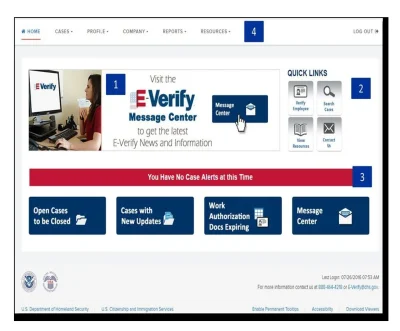
E-Verify 101. After a review of a new hire’s information from Section I of Form I-9, E-Verify employers must upload the completed form within three business days from the date the employee starts work for pay. Only one applicant can be verified at a time and the process cannot be used with existing employees.
The information on the new employee’s Form I-9 is then electronically matched against records from the databases of the Social Security Administration and the Department of Homeland Security. Once the form is uploaded to the E-Verify site, the new employee’s employment eligibility status is reported almost immediately.
If the applicant receives a Tentative Non-confirmation or TCN status, the employer is required to notify the applicant, who is provided a deadline to address the issue.
E-Verify 2.0. E-Verify has come a long way in the two decades since it was first introduced. In the recent years, the Department of Homeland Security has accelerated efforts to strengthen its capabilities, including a $131 million investment to fund enhancements, expand services and make important technological upgrades. In 2017, E-Verify transitioned to a new and improved cloud-based software system and earlier this year, rolled out a dedicated website, www.E-Verify.gov. The new website is easier to use and is also optimized for mobile devices. Both employers and employees have access to a wealth of helpful resources such as, training webinars, news and updates, performance reports and usage statistic, and information about employee rights and employer responsibilities.
Employees Only: myE-Verify
As a way to combat fraud, protect employee identities and educate workers, E-verify added a dedicated portal for employees called myE-Verify. The site features free tools for identity protection and checking employment eligibility.
Self Lock. Employees can lock their social security number to prevent unauthorized use and fraud within E-Verify.
Self Check. Accessing the same databases used by E-Verify, the Self Check tool allows jobseekers to check their eligibility status and make corrections before arriving to the Form I-9 stage. Pre-screening applicants is against the law. Therefore, employers can’t require new hires to use Self Check as proof of employment authorization.
MANDATORY ENROLLMENT
Are all businesses required to use E-Verify? It depends.
By federal law, all employers in the U.S. are required to complete a Form I-9 for every new employee. Currently, using E-Verify is only mandatory for federal contractors, state contractors, employers located in certain states, as well as companies participating in the Science, Technology, Engineering and Mathematics (STEM) program.
While E-Verify is available in all 50 states, the District of Columbia, Puerto Rico, Guam, and the U.S. Virgin Islands, only 22 states require employers to use it. And how each state requires employers to use E-Verify varies from state to state. For example, according to E-Verify laws in North Carolina, an employee is not considered an employee if the term of employment is less than nine months within a calendar year.
In addition, businesses are exempt from using E-Verify based on the number of employees which varies by state. In North Carolina, businesses with 25 employees or less are exempt, while businesses in Georgia, its 10 employees or less. And in some states, employers may be required to enroll in E-Verify in order to receive a business license.
For now, E-Verify does not provide guidance on state or local E-Verify laws, so it’s important to be familiar with the laws in your state.
As the Minneapolis employment agency learned, simple Form I-9 errors proved to be an expensive lesson. Penalties for compliance violations, such as a missing Form I-9, range from $110 to $1,100 per violation and more serious breaches, such as employing unauthorized workers, range from $375 to $16,000 per violation.
Here are some of the most common and errors to avoid:
Missing the 3-Day Deadline. Once an employee provides the required documents and identity information, employers must submit the completed Form I-9 within three days from the new hire’s start date.
Verifying Existing Employees. E-Verify isn’t a pre-screening tool. Once enrolled, E-Verify can only be used for new hires. It’s illegal to use selectively on current employees or other people.
Information Errors. In many cases, errors are due to a simple oversight, such as a missing social security number or failing to update a name change after marriage. Hire Date and Payroll Date Don’t Match. The date the employee begins to work for pay must match the date in payroll records.
Failing to address a Tentative Non-Confirmation (TCN). E-Verify employers are required to notify the new employee of a TCN status. The employee then has eight business days to address the issue. It’s illegal to terminate, suspend, refuse to pay or train, or delay the start date of an employee because of TCN status.
Invalid Identity Documents. To verify the identity and employment eligibility, new employees must provide, in person, the original documents from an approved list provided by the Department of Homeland Security. Copies, faxes and emails will be rejected.
Photos Do Not Match. Often employers make the mistake of comparing the employee’s photo on E-Verify to the actual employee. The photo on the employee’s Form I-9 and the photo on the employee’s original identity documents must match. Now compatible with smartphones and tablets, E-Verify’s new photo-matching tool helps to detect mismatched photos.
Using the Wrong Form I-9. Using an outdated or incorrect form is a common mistake. For example, employers are required to use the most recent version of Form I-9, which includes the date 7/17/2017 located at the bottom left-hand corner of the form. The Spanish version of Form I-9 is only valid for new hires in Puerto Rico.
Missing Form I-9 Records. In addition to keeping Form I-9 records for every employee, employers must also store records of terminated employees for one year after the termination date or three years after the hire date, whichever is later.
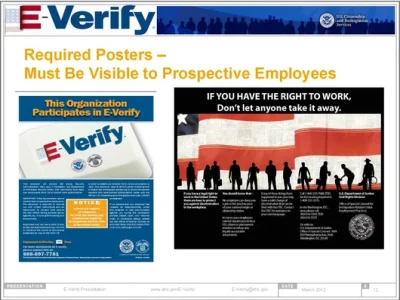
Missing Employment Eligibility Poster. E-Verify employers are required to clearly display the Notice of E-Verify Participation and Right to Work posters in both English and Spanish.
You can see why it’s important to establish strong employment verification procedures. Here are a few steps you can take now to protect your business.
Conduct a Compliance Review. Be proactive and implement a compliance review program. Review your current procedures for new hires and training. Audit your current Form I-9 records and make necessary changes to avoid potential compliance issues in the future. A company’s effort to make corrections before an investigation occurs will help to reduce penalties.
Train Employees. Train employees on procedures for completing Form I-9, using E-Verify and the requirements for staying compliant.
Consider an E-verify Employer Agent. Businesses can opt to outsource the employment verification process by hiring an E-Verify employer agent. In most cases, employer agents offer additional supporting services, such as background checks, legal assistance, payroll and accounting services.
READY OR NOT
Why enroll in E-Verify now? Increased efficiency, reduced chances for errors, and staying compliant are a few reasons companies are participating. While E-Verify is currently a voluntary program, change is coming. Smart businesses are staying ahead of the game by preparing for the inevitable national mandate, which immigration reform experts say could happen within the next three years – ready or not.
For the latest updates and more information about E-Verify, visit www.e-verify.gov.
Our clients have been saying nice things about us lately, and we really appreciate it! It’s part of the reason we do what we do. We love hearing your success stories and helping you grow your business. We take care of your employees like they’re our own so you can focus on your business and your own customers. Here’s a short video that animates what one of our clients recently said about Propel HR.
Growing small and mid-sized companies face numerous human resource (HR) challenges like tedious employee paperwork, payroll matters, and difficulties attracting and retaining top employee talent due to issues like unsatisfactory benefits. HR challenges can become a hindrance to the growth of your business.
It’s easy to overlook critical revenue-generating opportunities because your attention is distracted by your HR to-dos. The good news is that all you need to get up to par with your HR department is a professional employer organization (PEO). PEOs can work in tandem with your business to provide affordable and comprehensive payroll and human resource services through co-employment.
What is a PEO?
Professional Employer Organizations (PEOs) work with small and mid-sized businesses to help manage their payroll-related taxes, access to benefits, human resources tasks, as well as other administrative functions that are necessary for the smooth running of a business.
The essence of PEOs is dealing with the tasks above, which gives you time to focus on other aspects of your business—like growing it. Below are some examples of the functions PEOs can help out with:
Payroll tax registration in all the states that you have employees
Securing mandated insurances such as disability and unemployment
Accessing 401(k) that is easy to use and inexpensive
Obtainingmedical, vision, and dental coverage for your entire team at discounted rates
Filing payroll taxes and other government paperwork related to your employees
How a PEO works
PEOs take on all the above responsibilitiesfor you and your HR department because of a business-to-business(B2B) relationship called co-payment. A co-payment relationship allows a PEO to take on many of your employee-related duties so that you continue to manage and run other aspects of your business.
By signing acontract, a PEO will hire your employees and will be empowered to consolidate certain insurance and tax functions. The difference between outsourcing HR providers and using a PEO is that although the former can help your company prepare some paperwork, the latter goes as far as submitting it.
PEOs group numerous employees making them look likegiant entities during their negotiations with health insurers. Insurance companies charge all companies with less than 50 employees ‘’small group prices,’’ which is up to 30 percent higher than those companies with over 50 employees.
2. Cost Savings Through Hiring
Since PEOs provide HR support and manage most of your employment-related paperwork, you can delay making new HR hires. This also allows the HR department to focus on making your workplace better rather than struggling to keep the ship afloat.
3. Protect You Against Risk
A considerable number of smalland mid-sized business are fined annually for making payroll mistakes. Government compliance can be quite complicated with a lot of insurances to secure and paperwork to file. PEOs are expert employment-related compliance organizations that can handle most of the monotonous work.
4. Get Hours Back During the Day
For growing businesses like yours, it always feels like you are continually racing against the clock.With so much to do and not enough hours per day to do them, a PEO is a perfect answer that allows you to get multiple hours back every week.
As you can see, a PEO B2B relationship is beneficial for your fast-growing business because it is a one-stop shop for HR jobs. In turn, you are free to concentrate on other critical aspects of yourcompany. However, a PEO does not replace your internal HR staff or control your business.
My youngest daughter is a soccer fanatic. She plays the sport, watches the sport, and idolizes the players. Her room is decorated with posters of the U.S. Women’s Soccer team, which has won three Women’s World Cup titles, four Olympic gold medals, and countless other titles. The team has consistently been ranked as No. 1 or 2 in the world rankings for 20 years. Women’s soccer has become a sensation and it’s many wins have made the franchise financially successful. The U.S. women’s team has dramatically outperformed the men’s team which is currently ranked 28th in the world, yet the pay disparity between male and female players is huge. The players of the women’s team have been very vocal about this disparity and their activism led to a new contract being signed last year which narrowed the wage gap among players.
However, despite this victory for soccer, wage disparity between men and women is evident across all occupations. In 2017, women earned 82% as much as men according to the Pew Research Center analysis. That means that a woman performing an equal job would have to work an extra 47 days to earn what a man did in 2017. The gap is even larger for women of color: black women are paid only 65 cents and Hispanic women are paid only 58 cents on the dollar.
Why does this disparity still exist?
Women are often the predominant family caregivers which can lead to interruptions in career and can have an impact on long-term earnings.
Women tend to go into women dominated occupations such as education and nursing which do not pay as much as more male dominated field like engineering.
Men are more likely to negotiate for higher salaries than women.
Yet, regardless of these factors, there are still some unexplained factors that make up this gap such as discrimination and societal norms.
Interestingly, education levels do not help narrow this gap.
Women are more likely to graduate from college and more likely to receive graduate degrees than men, yet they are still paid less. In fact, according to the Economic Policy Institute, women with advanced degrees earn less than men with college degrees and straight out of college, women make $4 less than their male peers.
Our daughters deserve a future free of wage disparity.
I never played soccer, yet when I watch my daughter from the sidelines, I am proud of her determination and proud of the role models that she has found in the U.S. Women’s Soccer team. I believe strongly that when my daughters enter the workforce, they should be paid equal to men for equal work. The players on the U.S. Women’s team fought tirelessly to narrow the pay gap in soccer and their hard work has helped push changes among other sports. Our daughters deserve a future free of wage disparity.
Workforce analytics is more than an industry buzz word. It’s a powerful strategy for using data to manage a company’s most important asset – its workforce. And advances in software, like Human Resource Information Systems or HRIS, are rebooting HR departments with new capabilities for capturing and analyzing workforce data.
How do analytics work in HR? Analytics are used to collect, track and measure information about employees. Based on this body of data, analytics can be used to analyze patterns to predict outcomes and manage a workforce more efficiently.
A recent study conducted by the Society of Human Resources Management (SHRM) found that companies using workforce analytics as part of their overall business strategy achieved higher performing stocks, improved recruitment efforts, increased efficiency, and were three times more likely to realize costs savings.
When companies develop their business strategy, HR is generally not considered part of the process. But that mindset is changing. HRIS tools help companies manage people more as a business resource resulting in new ways to demonstrate value.
USING DATA TO DRIVE WORKFORCE DECISIONS
Workforce turnover can be costly. According to SHRM, the average cost-per-hire is $4,129 and the average time it takes to fill a position is 42 days.
Until new software options were available, HR practices have had to rely on do-it-yourself methods, spreadsheets and formulas to manage success. Manually tracking time and recording information is time-consuming, labor-intensive, and less effective for predicting changes influencing business, such as employee turnover.
What if you could identify the employees before they resign? Or address the factors causing employees to leave? What if you could prevent a drop in productivity before it happens?
HRIS workflow systems take the guess work out of managing talent. By organizing information from multiple sources into one central location with speed and accuracy, HR can focus more on strategies and workforce outcomes. It also delivers the analytics necessary to keep goals on track and the guidance to reach those goals. Here’s how.
For example, if your business requires employees to perform a specific duty within a certain amount of time, such as moving, plumbing, or pest control treatment, it can be a challenge to budget and manage labor. HRIS assessment tools allow you to analyze the history of similar jobs, including the number of labor hours and workers required, in order to manage future jobs. And analytics that combine information about performance levels with retention data can be useful in predicting potential turnover.
More accurate data translates to a more efficient workforce results in cost savings to your company. By linking workforce data to business outcomes, it’s easy to see how companies with the advantage of HRIS tools would outperform companies without it.
COMPETITIVE ADVANTAGES
Using secure cloud-based technology, HRIS unifies the different HR processes and a variety of tools can be customized to use information in more strategic ways. Benefits include:
MORE ACURATE DATA. Because employees can update personal information in real time, employers have more accurate data available for payroll, performance and benefits.
SAVES TIME. A self-service portal for employee access and automated features for streamlining processes, such as open-enrollment for healthcare, help HR departments operate more efficiently. As a result, HR managers can focus on more important initiatives, like hiring strategies and department outcomes.
REDUCES RISKS. A compliance violation can send your business into a tailspin. Because HR is the front line for protecting employees, integrating solutions to reduce risks is more important than ever before. HRIS makes it easier to navigate the complexities of staying compliant with new and changing workplace laws and regulations. Here are a few examples:
Wage and Hour Law Support. Companies are legally required to pay overtime and the failure to so can be costly if not paid in accordance with state and federal laws. Do you know which employees need to be paid overtime and which employees are exempt?
Automated wage and hour capabilities report on changes in regulations and provide regular updates on laws affecting your specific industry. In addition, it more accurately records hours worked, including break periods, and alerts employees about approaching limits for overtime, sick leave and personal days.
Discrimination and Sexual Harassment. A pregnant employee requests to transfer to another division for a position which requires lighter lifting responsibilities. But the company has reserved this job for employees with disabilities. Is pregnancy considered a disability? Your employee, who is a new mother, needs a private space to breastfeed during work hours and is using the only empty office available. But the door doesn’t have a lock. Are you required to accommodate this employee so she can feed her baby?
As the saying goes, ignorance is not an excuse when it comes to the law. HRIS systems help companies educate employees with access to company policies and procedures, as well provide the training tools and information on employment law.
Correcting Oversights. While your business may not intend on breaking the law, mistakes happen. HRIS keeps your business compliant by providing up-to-date information on the latest issues impacting HR, from recruitment to retirement. It also identifies potential discrepancies, such as payroll calculations or missing benefit forms, before a compliance violation occurs.
HRIS TOOLS
Most companies start with the following core tools:
Database. The flexibility of cloud-based technology enhances the process for collecting workforce information. As the backbone of HRIS workflow, the database unifies all of the information from other HR functions into one location.
Time and Labor Management. According to the Society of Human Resources Management’s report on the Financial Impact of Employee Absences, the cost of overtime due to absences costs a business an average of 5.7 percent of payroll. HRIS features help HR managers gain control over labor costs with tools to verify time and attendance data leading to more accurate payroll calculations and automation options to configure more productive workflows schedules.
Integrated Payroll Services. HRIS payroll function are designed to streamline the payroll process by capturing real-time data, managing tax and compliance requirements, and automated solutions for check distribution and direct deposits.
Health and Retirement Benefits. Employees can manage retirement investments, medical benefits and easily download documents to expedite processing.
Custom and Advanced Features. Customized features give employers a more in-depth understanding about their employees, including information on volunteer activities, participation in wellness programs, additional education certification, the number of new hire referrals provided, performance reviews and training progress.
Compensation Management. Features like the compensation management function are valuable for simplifying the pay process and for determining salary levels, bonus and commission structures. It’s also guides long-term planning and support for rewarding employee performance.
Recruitment Tracking. According to Career Builder’s annual report on recruitment, 58 percent of HR managers surveyed say they have job openings that remain vacant for 12 weeks or more and 40 percent of those currently working plan to change jobs within a year.
With numbers like this, companies need to integrate more strategic methods for attracting qualified candidates. HRIS addresses recruitment challenges with comprehensive tools for sourcing candidates, identifying skill sets, managing job postings and resumes, and keeping job descriptions up to date. It also simplifies the hiring process by tracking applicants, managing job offers and once hired, initiates the onboarding process.
Employee Training and Retention. A number of studies suggest that investing in employee training has a direct impact on the company’s bottom line.
According to a study conducted by The American Society for Training and Development (ASTD), businesses that provided extensive training to their employees achieved 218 percent more income per employee than companies with non-comprehensive training programs. It also found that employees who received poor training or lack of training, leave their job within the first year.
And a study conducted by Career Builder found that 66 percent of companies plan to invest in more employee training and development as a way to bridge skills gap and to prepare employees for future roles.
HRIS helps identify the employees requiring additional training support and it provides educational tools and courses to strengthen skills. In addition, managers are able to monitor employee performance against career goals to keep employment strategies on track.
NEW TOOLS REQUIRE NEW THINKING
With so many advantages, why are companies slow to adopt HRIS? Budget restrictions and limited applications are a few reasons. But that’s changing. Over the past five years, more affordable options in HRIS technology have entered the HR space. Another reason is a disconnect between HR and the company’s business strategy. If you don’t have a solid understanding about the goals of your company, how can you determine the tools needed to be successful?
While HRIS won’t replace the role of HR, it has however, reinvented it. The role of today’s HR department is more business-minded. By aligning HR services with company goals, HRIS tools provide organizations with the business muscle to boost efficiency, create more effective workforce strategies, and provides the guidance to make important decisions impacting company performance.







 Maintaining inefficient processes limits growth, slows project delivery, and prevents your team from focusing on strategic initiatives.
🛠️ How To Fix It: Partnering with an IRS-certified PEO can help. By taking on time-consuming tasks, PEOs help small businesses get back more time to focus on productivity and growth.
In addition to saving time, a PEO can also save your business money by identifying inefficiencies, streamlining HR processes, and helping you make critical cost-cutting decisions.
Maintaining inefficient processes limits growth, slows project delivery, and prevents your team from focusing on strategic initiatives.
🛠️ How To Fix It: Partnering with an IRS-certified PEO can help. By taking on time-consuming tasks, PEOs help small businesses get back more time to focus on productivity and growth.
In addition to saving time, a PEO can also save your business money by identifying inefficiencies, streamlining HR processes, and helping you make critical cost-cutting decisions. 



 When HR productivity is dialed in, your entire team plays better.



 A PEO lays the foundation before those cracks show. Payroll scales without drama. Whether you have 10 people or 110, payroll stays smooth, compliant, and on time.
Onboarding becomes a real process and not a scramble. Templates, checklists, digital forms, background screening, and automated workflows ensure consistency as you grow.
Policies adjust proactively. A PEO helps you build employee handbooks, update them with new laws, and create clear rules that reduce risk as your headcount increases.
A PEO lays the foundation before those cracks show. Payroll scales without drama. Whether you have 10 people or 110, payroll stays smooth, compliant, and on time.
Onboarding becomes a real process and not a scramble. Templates, checklists, digital forms, background screening, and automated workflows ensure consistency as you grow.
Policies adjust proactively. A PEO helps you build employee handbooks, update them with new laws, and create clear rules that reduce risk as your headcount increases.  This is where many small businesses unintentionally step into danger territory. The rules change constantly and the stakes are high.
 If you’re a business owner, your job is to grow the business, not troubleshoot payroll deductions. If you’re an HR manager, your job is to support the people strategy, not drown in admin work.
 ✅Build modern HR processes that employees trust.
 With a PEO, growth is a plan.
 🔶HR Help Wanted: In-house Team or PEO Partner. Investing in an HR team versus partnering with a PEO, which path is best for your small business? As your business grows, managing HR gets complicated – fast. Should you build your own HR team or explore the benefits of partnering with a PEO? Here’s how to decide which choice best fits your business.
  🔶Navigating Compliance Minefields. Navigating HR compliance can feel like tiptoeing through a minefield — one wrong move can trigger costly consequences. From pay transparency laws to overtime thresholds, new regulations evolve faster than most small HR teams can keep up with. Here’s a look at the top HR compliance challenges and how to avoid turning small missteps into expensive lessons.
  🔶New Research Shows Why More Small Businesses Are Turning to PEOs. The data is in! And it shows how partnering with a PEO will be the smartest move for small businesses in 2026. Recently released



 The AHA adopted the Blue Cross symbol as the emblem for meeting these standards and as a way to differentiate itself from other for-profit plans.




 As I’ve grown older, I appreciate my father’s advice so much more. My network is more than just contacts on my computer. It is a wonderful group of individuals who have helped me throughout my career both professionally and personally. I am grateful for each person and the benefits and lessons I have learned along the way. (Photo: Lee Yarborough and her father, Brax Cutchin)
 Depending on the location of your business, the makeup of your workforce may include predominately Millennials or a mix of multi-generations. As part of a study on Millennials, The Brookings Institution recently created an interactive map to break down the population of Millennials in 100 of the largest metro areas in the country.
 to narrow the gender wage gap does not fall on businesses alone. Women have a responsibility as well to not only fight for equal rights but to be a part of the solution. The pay gap won’t change overnight and I realize that my daughters will also have to work towards equity. When it is time to begin their careers, I hope they will remember my motherly advice: negotiate salary with skill and confidence; know what your job is worth in the marketplace; find a mentor; don’t be afraid to use your voice; and most importantly, Work Hard.